
An autonomous AI agent with system-level access isn't a productivity tool; it's an unmapped attack surface. Most enterprises grant these agents deep access to databases and code repositories without a single millisecond of runtime oversight. You already know the risk. A single prompt injection or unauthorized data exfiltration bypasses traditional perimeter defenses instantly. The Sentinel Beacon Control Plane ends this era of operational blindness. It provides the definitive command center for autonomous agent governance. It is the ultimate safeguard against the chaos of unmonitored AI.
You need more than a post-action audit. You require a system that intercepts risk before execution occurs. This article demonstrates how to master the architecture of the industry's first runtime governance engine. We will detail the deployment of Sidecar Interceptors for zero-code integration across 60+ platforms. You will learn to implement real-time risk scoring that evaluates security policies in under 1 millisecond. We will also cover the generation of PQ-ML-DSA cryptographic compliance logs for absolute regulatory certainty. This is your blueprint for total AI visibility, containment, and enforcement.
Key Takeaways
- Establish the Sentinel Beacon Control Plane as your centralized command center. Intercept autonomous agent risks at runtime to replace reactive, post-hoc logging.
- Deploy Sidecar Interceptors for zero-code integration across 60+ platforms. Achieve immediate policy enforcement without modifying existing application source code.
- Secure audit trails with post-quantum-ready cryptographic evidence. Provide mathematical certainty for regulators and high-stakes internal compliance teams.
- Implement a "DENY-first" policy engine to eliminate "Shadow AI." Maintain total containment over agents with access to sensitive enterprise systems.
- Scale AI adoption by evaluating security policies in under 1 millisecond. Ensure governance never functions as a bottleneck for mission-critical system performance.
Defining the Sentinel Beacon Control Plane: The Command Center for AI Agents
The Sentinel Beacon Control Plane serves as the definitive intelligence layer for autonomous AI governance. It is not a passive observer. It is the centralized command center. In complex infrastructure, the control plane functions as the brain that manages system topology and directs traffic. For AI agents, this architecture provides the strategic oversight required to manage high-stakes workflows. It imposes order on unruly environments. It replaces ambiguity with technical rigor.
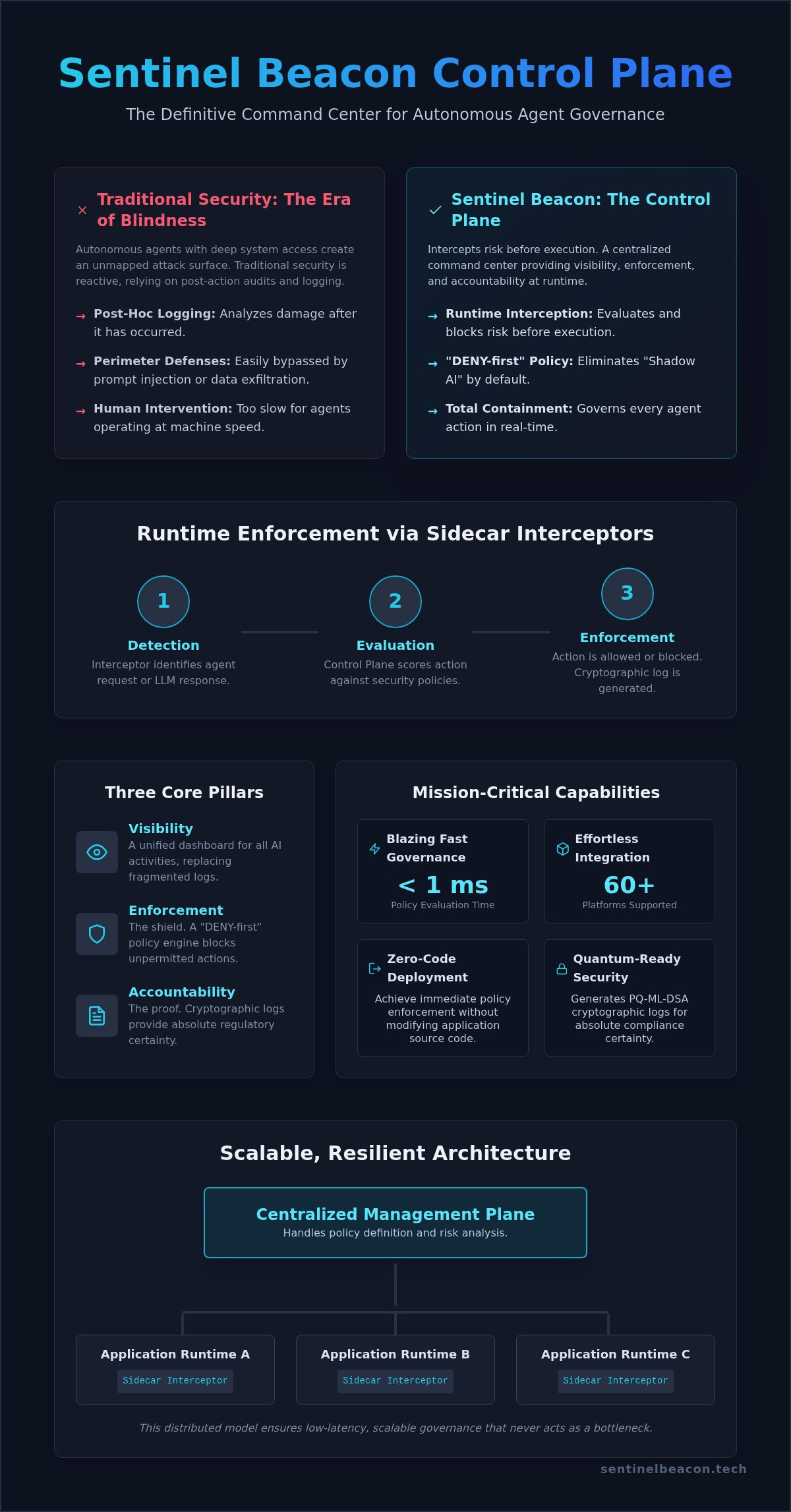
Traditional security models rely on post-hoc logging. This is reactive and insufficient. Logging tells you how the system failed after the damage is done. The Sentinel Beacon Control Plane operates at runtime. It intercepts intent before execution. It replaces vague oversight with mathematical certainty. Every decision flows through three core pillars: visibility, enforcement, and accountability. Visibility provides the map. Enforcement provides the shield. Accountability provides the proof.
The Shift from Monitoring to Active Governance
Passive monitoring fails in autonomous environments. Agents operate at speeds that exceed human intervention. Real-time risk scoring is the only viable defense. The control plane evaluates every prompt and response against your specific security posture in under 1 millisecond. It functions as a single pane of glass for all AI activities. You don't hunt through fragmented logs. You manage a unified dashboard of active enforcement. This shift moves your team from a defensive crouch to a position of total command. Governance becomes an enabler of speed rather than a bottleneck.
Core Components of the Sentinel Beacon Architecture
The architecture utilizes a distributed model for maximum resilience. A centralized management plane handles policy definition and risk analysis. It communicates with distributed agents via Sidecar Interceptors. This separation ensures that governance remains scalable and low-latency. It is a battle-hardened design built for environments where error is not an option.
The system relies on two critical modules to maintain containment:
- AI Identity Management: This module assigns unique, verifiable identities to every agent. It prevents "Shadow AI" and ensures every action is mapped to a specific, authorized entity.
- The Policy Engine: This is the enforcement heart of the system. It utilizes "DENY-first" logic to block any action not explicitly permitted by your governance framework.
This structure provides a "zoomable" view of your AI ecosystem. You see the high-level strategic vision and the granular, millisecond-level interventions simultaneously. It is the only way to secure autonomous agents at scale.
Runtime Enforcement via Sidecar Interceptors: How it Works
The Sentinel Beacon Control Plane requires a physical presence at the edge to execute its mandates. Sidecar Interceptors function as the "boots on the ground" for this architecture. They reside directly within the application runtime. They capture every bit of data flowing between the autonomous agent and the Large Language Model (LLM). This positioning ensures that no action occurs in a vacuum. Every intent is scrutinized before it reaches the external provider. It is the definitive method for maintaining containment in a high-stakes environment.
Deployment is instantaneous. The system utilizes a zero-code integration model that eliminates the need for custom development or framework refactoring. You don't rewrite your agent's core logic. You inject the interceptor into the environment. It wraps the execution path. This provides immediate, enterprise-wide governance across 60+ supported platforms. Performance is a mission-critical priority. The interceptor evaluates security and compliance policies in under 1 millisecond. Governance remains invisible to the user but absolute in its authority.
The Interception Lifecycle
Every agent action follows a rigorous three-step verification process. This sequence happens in real time. It ensures that only authorized, safe actions proceed to execution.
- Detection: The interceptor identifies an outbound agent request or an inbound LLM response. It captures the full context of the interaction.
- Verification: The interceptor queries the Sentinel Beacon Control Plane. It checks the action against the central policy engine and the agent's specific identity permissions.
- Mitigation: Based on the risk score, the system takes immediate action. It allows the request, sanitizes sensitive data, or triggers a kill switch to quarantine the agent in under 1 second.
Blocking Prompt Injection and Data Exfiltration
Prompt injection is a structural vulnerability that traditional firewalls cannot detect. Sidecar Interceptors analyze semantic intent to identify malicious overrides. They block attempts to bypass system instructions or access restricted internal data. This proactive stance aligns with the NIST AI Risk Management Framework. It moves your security posture from reactive logging to active prevention.
Data exfiltration is a constant threat when agents have access to sensitive repositories. The interceptor enforces Role-Based Access Control (RBAC) at the prompt level. It prevents an agent from querying payroll databases if its identity is restricted to customer support tasks. If an unauthorized data leak is detected in a response, the interceptor scrubs the output before it reaches the end user. Organizations ready to secure their autonomous workflows should explore Sentinel Beacon licensing for comprehensive runtime protection. This is how you impose order on the unruly reality of autonomous AI.
Cryptographic Evidence: Proving Compliance in an Autonomous World
Standard text logs are a liability in a high-stakes enterprise environment. They are mutable, fragmented, and insufficient for legal defense. If an autonomous agent triggers a catastrophic data leak, a simple text file won't satisfy a regulator or a board of directors. You need mathematical certainty. The Sentinel Beacon Control Plane replaces passive logging with Cryptographic Evidence Logs. These are not merely records; they are immutable proofs of intent and action. Accountability is no longer a manual process. It is a system property.
Every interaction captured via the Sidecar pattern is cryptographically signed at the moment of interception. This creates a technical chain of custody that's impossible to alter. The control plane ensures that every prompt, response, and policy decision is locked into a permanent audit trail. It moves the burden of proof from your engineering team to a mathematical algorithm. You don't just report on what happened. You provide verifiable evidence that it could not have happened any other way. This is the definitive standard for operational oversight.
Audit-Ready Workflows for Regulated Industries
Regulated industries face increasing pressure from frameworks like the EU AI Act. These mandates require total transparency into how AI models make decisions and how they're governed. The Sentinel Beacon Control Plane automates this compliance. It generates verifiable reports that map every agent action to a specific policy. This visibility transforms audits from a multi-week crisis into a routine status update. You provide regulators with the exact data they demand without manual data mining. Verification becomes a background task rather than a resource drain.
- Automated Reporting: Produce audit-ready documentation for SOC 2 or ISO 42001 in seconds.
- Intervention Proof: Demonstrate exactly when the "Human-in-the-loop" workflow was triggered for high-risk operations.
- Policy Mapping: Link every blocked injection attempt to its specific governance rule.
Post-Quantum Security for AI History
The value of your AI history increases over time. However, traditional encryption is vulnerable to future quantum threats. Sentinel Beacon future-proofs your compliance record by using PQ-ML-DSA signatures. This post-quantum-ready architecture ensures that your audit trails remain valid for decades. You're not just securing today's logs. You're protecting the long-term integrity of your enterprise intelligence. Verifiable AI decision-making history is a strategic asset. You must protect it with the highest level of technical rigor. Cryptographic Evidence is the immutable record of AI intent and action. It provides the permanence required for an autonomous world.
Deployment Strategy: Zero-Code Integration for 60+ Platforms
Security is often the enemy of speed. The Sentinel Beacon Control Plane reverses this dynamic. It eliminates the requirement for custom development or specialized security refactoring. You don't rewrite your agent's core logic to achieve compliance. You deploy once and enforce everywhere. This philosophy ensures that governance scales at the speed of your innovation. It is a battle-hardened strategy for diverse, high-pressure AI ecosystems. You maintain total containment across every touchpoint without adding a single line of code to your application source.
The system supports over 60 integrations. This includes major LLM providers like OpenAI, Anthropic, Google Gemini, Azure OpenAI, and AWS Bedrock. It extends to orchestration frameworks like LangChain, CrewAI, and AutoGen. Even enterprise communication and identity tools like Slack, Microsoft Teams, Okta, and Splunk are covered. The Sentinel Beacon Control Plane functions as the universal translator for AI risk. It speaks the language of your existing stack. It imposes order on fragmented infrastructure. It is the definitive solution for the modern, AI-enabled enterprise.
Scaling AI Governance Across the Enterprise
Managing fragmented AI projects is a high-risk endeavor. A centralized interface provides the only viable solution. You oversee multiple agent types from one location. Policy enforcement remains consistent across different business units. Marketing agents and financial analysis agents follow the same core security mandates. This architectural consistency reduces the total cost of ownership (TCO) for AI security. You stop paying for redundant, siloed security layers. You start leveraging a unified control plane that offers total visibility. Efficiency and security are no longer a trade-off. They are a combined outcome.
The Integration Roadmap
The path to runtime governance is methodical and rapid. It follows a tactical sequence designed for zero downtime. First, connect your existing AI agents to the control plane. The system utilizes lightweight Sidecar Interceptors or SDKs to wrap the execution path. Next, configure your security posture. You establish global policies for the entire enterprise while refining local policies for specific agent roles. Finally, test enforcement. You validate the ruleset in shadow mode before moving to active blocking. This ensures that governance never disrupts production workflows. Secure your infrastructure today by obtaining Sentinel Beacon licensing for your entire agent fleet. This is the commander's choice for secure AI deployment.
The roadmap is built for flexibility. You can deploy the control plane as a SaaS, within a dedicated tenancy, or fully on-premise within your VPC. This versatility meets the needs of air-gapped or FedRAMP environments. You choose the deployment model that matches your risk profile. The system handles the rest. It is fast. It is direct. It is efficient.
The Strategic Mandate: Why Enterprise AI Requires a Control Plane
Unmanaged autonomous agents are a systemic vulnerability. "Shadow AI" is no longer a theoretical concern; it's a current failure of enterprise oversight. Every agent operating without a centralized intelligence layer is an open invitation to prompt injection and data exfiltration. You cannot secure what you cannot see. You cannot govern what you cannot intercept. The Sentinel Beacon Control Plane is the only definitive response to this era of operational chaos. It doesn't function as a barrier to innovation. It serves as the essential infrastructure that makes innovation safe.
Governance is your primary competitive advantage. Organizations that rely on reactive monitoring will inevitably face regulatory scrutiny and security breaches. Those who implement runtime enforcement move with confidence. This is the mandate of the Authoritative Guardian. You must establish a perimeter that is mathematically certain. You must provide audit trails that are cryptographically immutable. The choice is binary: maintain total containment or accept total risk. There is no middle ground in high-stakes environments.
Future-Proofing the AI Perimeter
The threat landscape is evolving rapidly. By 2026, agent hijacking will become a primary attack vector for sophisticated actors. Attackers won't just seek to confuse an LLM; they will attempt to co-opt the agent's identity to move laterally through your network. AI Identity Management is the only defense against this evolution. It ensures that every action is tied to a verifiable, authorized entity. The Sentinel Beacon Control Plane provides the foundation for all future AI initiatives. It secures the identity, the intent, and the outcome. Without this architecture, your AI strategy is built on a foundation of unmanaged risk.
Securing the Future with Sentinel Beacon
The mission is clear: visibility, containment, and enforcement. You require a system that evaluates security policies in under 1 millisecond. You need a kill switch that can quarantine a compromised agent in under 1 second. Verifiable AI governance is not a checkbox; it's a strategic asset that allows you to deploy autonomous agents where others fear to tread. It provides the permanence and reliability required for mission-critical systems. The era of unmonitored AI must end today. Deploy the Sentinel Beacon Control Plane to secure your AI agents today. This is the definitive standard for enterprise protection. Secure your perimeter. Establish total command. Protect your intelligence.
Establish Total AI Command
Autonomous agents are no longer a future roadmap item; they are a current operational reality. Relying on passive monitoring is a strategic failure. You need the Sentinel Beacon Control Plane to impose order on the AI perimeter. This architecture provides the millisecond-level enforcement required to stop prompt injections and data leaks before they occur. It transforms your security posture from a reactive defensive crouch into a position of total command. You gain visibility into every agent action while maintaining the power to intervene instantly.
Implementation is rapid and efficient. With zero-code integration across 60+ platforms, you can secure your entire agent fleet without disrupting production workflows. You gain post-quantum-ready cryptographic logs that provide mathematical certainty for any auditor or regulator. These immutable records prove compliance and reduce the burden of oversight. This is the definitive standard for enterprise AI governance. Establish your command center today. It's time to move from uncertainty to absolute enforcement.
Secure your enterprise AI agents with the Sentinel Beacon Control Plane. Take control of your autonomous future.
Frequently Asked Questions
What is the Sentinel Beacon Control Plane?
The Sentinel Beacon Control Plane is the centralized command and control layer for enterprise AI governance. It provides the strategic oversight required to manage autonomous agents at scale. It replaces fragmented, reactive logging with a unified, runtime intelligence layer. This architecture ensures total visibility into agent intent and action. It is the definitive safeguard for mission-critical AI infrastructure.
How does the Control Plane enforce policies in real time?
Real-time enforcement occurs through the evaluation of security policies in under 1 millisecond. The system intercepts every interaction before it reaches the LLM provider. It utilizes a "DENY-first" policy engine to block unauthorized actions by default. This ensures that governance happens at the speed of execution. There is no room for lag or ambiguity in high-stakes environments.
What are Sidecar Interceptors for AI agents?
Sidecar Interceptors are lightweight components that reside within your application runtime. They function as the "boots on the ground" for the control plane. They capture and inspect every bit of data flowing between the agent and the model. This positioning allows for immediate intervention without requiring changes to your core application logic. It is a battle-hardened method for edge-level enforcement.
How does Sentinel Beacon handle prompt injection attacks?
The system handles prompt injection by analyzing the semantic intent of every outbound request. It identifies and blocks malicious overrides designed to bypass system instructions or access restricted data. This proactive containment prevents agents from being co-opted by adversarial prompts. It moves your security posture from a defensive crouch to active prevention.
Why is cryptographic evidence important for AI compliance?
Cryptographic evidence provides an immutable, mathematically certain record of AI activity. Standard text logs are easily altered and insufficient for rigorous regulatory audits. Sentinel Beacon generates signed evidence that establishes a technical chain of custody. This satisfies the transparency requirements of frameworks like the EU AI Act. It provides the proof necessary for high-stakes accountability.
Can Sentinel Beacon integrate with my existing AI agents without code changes?
Yes. The Sentinel Beacon Control Plane features zero-code integration for over 60 platforms. You deploy Sidecar Interceptors or SDKs to wrap existing execution paths. This eliminates the need for expensive refactoring or custom development. You achieve enterprise-wide governance in hours rather than months. It is the most efficient path to secure AI adoption.
Is the Sentinel Beacon Control Plane post-quantum secure?
Yes. The platform uses post-quantum-ready PQ-ML-DSA signatures for all evidence logs. This ensures your audit trails remain secure against future quantum computing threats. You aren't just protecting today's operations. You are securing the long-term integrity of your enterprise intelligence. It is a commitment to permanence and reliability.
How does the Control Plane manage AI agent identities?
AI Identity Management assigns a unique, verifiable identity to every agent in your ecosystem. This prevents "Shadow AI" by ensuring every action is mapped to an authorized entity. It allows for granular Role-Based Access Control at the prompt level. You maintain total command over who, or what, is accessing your sensitive data repositories.